Integrating new technologies to overcome technical challenges
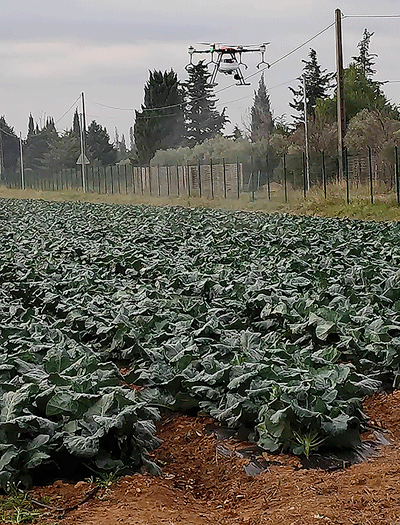
Committed to supporting our customers in an ever-changing agricultural world, we began exploring drone spraying a few years ago. What started as simple technical curiosity became a reality when we saw that this technology could be integrated into our technical itineraries.
As part of our initial research, we found that:
- The issue of drones was often raised but was generally limited to the use of pesticides on steeply sloping vineyards.
- the claims did not match the reality on the ground when it came to spraying large areas at an affordable cost
After consulting with various experts, we selected a service provider capable of adapting its equipment to our specific needs.
This was followed by a series of tests, in particular to validate the volume of water, a key factor in drone spraying. With this technique, even more so than with a conventional sprayer, the volume of water directly affects the cost per hectare. We therefore defined a water volume and product concentration that would ensure optimal distribution and effectiveness on the plants.
Since 2021, we have been regularly using this spraying method to address technical constraints related to difficulties in accessing plots.
This may be due to:
- thespace occupied by the crop, as in the case of mother vines or squash
- weather conditions that sometimes make access to fields impossible.
Let's takesquash as an example:
Most large squash are difficult to market. To promote smaller fruits without compromising overall yield, our biostimulant program not only increases the number of fruits, but alsoimproves plant resistance and fruit quality.
In this specific case, the drone overcomes the technical constraint of not being able to pass through the squash crops after a few weeks of growth due to space limitations.
Last year, thanks to the use of drones, we were able to implement our program on 250 hectares, thereby optimizing squash cultivation.
Last but not least, we received positive feedback from local residents who "appreciated" the natural biostimulant and drone approach.
This is undoubtedly also because drones are a technology accessible to all and are not associated in the collective imagination with the use of plant protection products.