Crops grown in unbalanced soil environments or those subject to significant biological pressures may have more difficulty establishing roots and may have limited nutrient uptake. In these contexts, the quality of the soil's biological functioning plays a decisive role in plant vigor and production potential.
Developed using the expertise of Biodevas Laboratoires, GLUCOSOIL is a 100% natural biostimulant based on plant extracts, designed to support the plant's natural mechanisms and improve the biological environment of the rhizosphere.
Its action is based in particular on stimulating the production of glucosinolates, secondary plant metabolites involved in interactions between the plant and its environment.
Used in market gardening, arboriculture, and Industrial Vegetables, GLUCOSOIL is part of agronomic strategies aimed at securing crop establishment and preserving yield potential, even under difficult production conditions.
Glucosinolates: key molecules in the soil ecosystem

Glucosinolates are secondary metabolites naturally produced by certain plants, which are then broken down in the soil by enzymatic and microbial processes.
This transformation leads to the formation of volatile sulfur compounds, particularly isothiocyanates, known for their biological activity, on which biofumigation mechanisms are based.
In the rhizosphere, these compounds contribute to local changes in the biological environment of the soil and influence the balance of microbial communities.
The induction of glucosinolates and their transformation in the soil contribute in particular to:
- Improve soil biological activity.
- Stimulate certain bacterial populations involved in mineralization.
- Promote slight localized acidification linked to the release of sulfur compounds.
- Increase the return of organic biomass.
These phenomena help to create an environment that is more favorable to root development and the physiological functioning of the plant.
GLUCOSOIL: a biostimulant to activate the soil's natural mechanisms
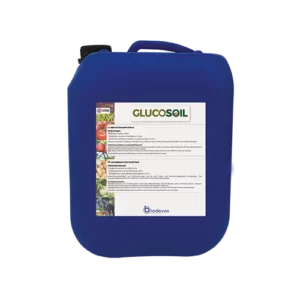
GLUCOSOIL works by stimulating the natural processes of the plant and the rhizosphere through a formulation derived from plant extracts.
Its composition is based on several plants rich in bioactive compounds: black radish, horseradish, dandelion, and fenugreek.
These plant extracts, obtained using the extraction process developed by Biodevas,activate the plant's self-elicitation mechanisms andinteract with the biological balance of the soil.
The goal is to improve growing conditions for the crop from the earliest stages of establishment.
A direct effect on root development
The biological functioning of the rhizosphere directly influences the structure and efficiency of the root system.

Tests conducted with GLUCOSOIL in different soil and climate conditions have highlighted several effects on the root system:
- Increase in pivot length.
- Increased development of rootlets.
- Better exploration of soil volume.
A more developed root system improves access to water and nutrients, while strengthening the plant's ability to adapt to environmental constraints.
Agronomic benefits observed in the field
Improvements in soil biology and root development translate into measurable agronomic benefits.
In various growing contexts, the use of GLUCOSOIL has resulted in the following observations:
- Improved crop vigor.
- Better plant establishment.
- Greater root development.
- Securing the potential return.
- An improvement in the sanitary quality of crops.
These effects are particularly interesting in difficult production situations, especially in unbalanced soil environments or those subject to significant biological pressures.
Example of testing under real production conditions
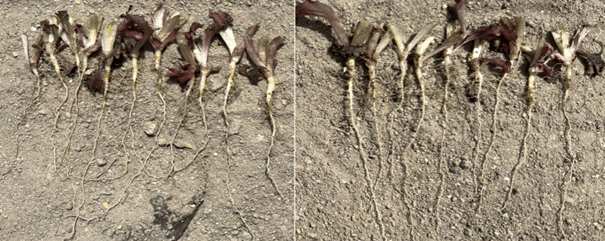
In particular, a trial was conducted in 2025 on a vegetable farm located in Saint-Julien-de-Concelles (Loire-Atlantique, France), on a plot of young red shoots.
The trial was conducted in the field to evaluate the effect of GLUCOSOIL on crop development under real production conditions.
The early stages of the crops were treated with the Biodevas program, which included two applications of GLUCOSOIL: one application at emergence and a second application seven days later.
These methods were compared to the producer's usual protection program, based in particular on the use of Ortiva.
Observations made during the cycle showed greater root development in areas treated with GLUCOSOIL, promoting better crop establishment.
At harvest time, this improvement resulted in a 5% increase in box weight compared to the producer's benchmark.
These results illustrate the benefits of GLUCOSOIL in stimulating crop vitality and ensuring agronomic performance, particularly in intensive vegetable growing systems.
Conclusion
Improving the biological functioning of soil is now an essential lever for securing agricultural production.
By stimulating the production of glucosinolates and their transformation in the rhizosphere, GLUCOSOIL helps create an environment that is more favorable to root development and crop growth.
Thanks to its unique mode of action and its potential for integration into different cropping systems, it fits into agronomic strategies aimed at strengthening plant resilience and securing yields in increasingly constrained production contexts.
Would you like to learn more about GLUCOSOIL or how to use it on your crops?
Contact our team, who are available to answer your questions and assist you with your trials.
FAQ – Soil biostimulants
What is a soil biostimulant?
A soil biostimulant is a substance or microorganism that stimulates natural processes in plants or the rhizosphere to improve nutrient uptake, stress tolerance, or crop quality.
What are glucosinolates?
Glucosinolates are secondary metabolites produced by certain plants. Their degradation in the soil can generate sulfur compounds with biological activity that regulates soil biological life and stress, but also has antioxidant activity for crops.
What is biofumigation used for?
Biofumigation involves grinding plant cover (such as mustard) and incorporating the residues into the soil, which then release volatile organic compounds that alter the biological environment of the soil and promote a balance that is more favorable to crop development.