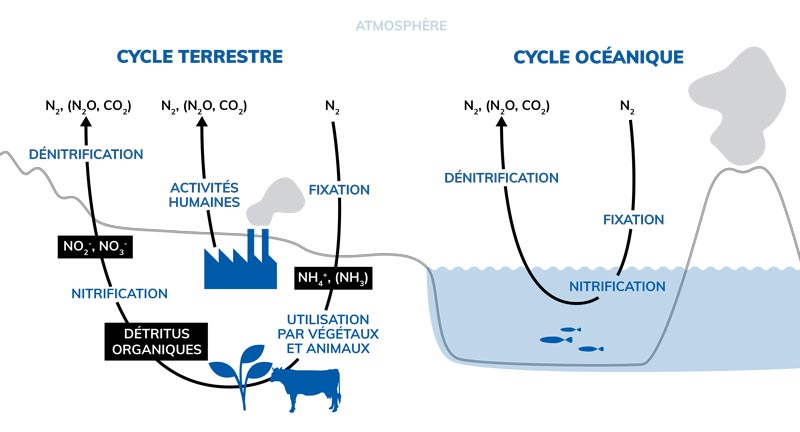
Nitrification is the biological process by which nitrates are produced in the environment. It occurs in two distinct stages, each involving different microorganisms.
Source: Nitrogen cycle – Laval University, Quebec City
Stage 1: ammonia is oxidized into nitrite, a process known as nitritation (a reaction involving bacteria of the Nitrosomonas, Nitrosococcus, and Nitrosospira genera, also known as nitrosation).
Step 2: Nitrite is oxidized into nitrate, a process known as nitrification (reaction by bacteria of the genus Nitrobacter, Nitrococcus, Nitrospira). In this process, which takes place in neutral, oxidizing soils without too much organic matter (competitive heterotrophy by saprophytic bacteria), the oxidation of nitrogen by these bacteria provides them with the energy they need to convert CO2 into organic matter (autotrophy). The toxic waste nitrites produced by the first bacterial community are used as metabolites by the second. This symbiotic phenomenon is called syntrophy.